Osnabrück

The usual 30km ride from the ferry to Rotterdam Centraal – into a headwind, which is just unfair. I’m more familiar with that ride now that routes around my own neck of the woods. Then trains to Amersfoort and then Osnabrück. I just ask people to help me get my bicycle and panniers onto the high trains.

The list of things that can go wrong has grown. Last-minute platform changes I am used to (there was one at Leeds yesterday that set me running), but today I was introduced to the sense of ignorant helplessness you feel when everybody else knows what is going on because they are on the app and act as one – leaving me stranded. We were all waiting on platform 14 when, like a shoal of fish, everyone turned and started flowing down the escalator. No announcement – just a hive-mind connected by the app. Someone said “twaalf” to me, so I dashed to platform 12. There was a train – still no announcement – and I stood by the door with the bicycle symbol. Another mass flow – the train was only the front half.

Anyway I got to Amersfoort – and discovered that I was in time to catch the much-delayed Berlin train that calls at Osnabrück. I had a flexible ticket so that was OK, but I didn’t have a bicycle reservation for that particular train. Since my bicycle was the only one in the racks, I don’t think I inconvenienced anyone.

Upshot: on a day of train traumas, I got to Osnabrück an hour earlier than expected.

But the real depth charge to hit my holiday is today’s announcement that there are strikes on some Dutch trains from tomorrow. I’d already factored in Sunday’s closure of Osnabrück station to remove a bomb (if I’ve translated correctly) and its impact on my vague plans, but the thought of Dutch trains being unreliable when I was relying on them to carry me across the country on Monday is too much. So farewell Bremen and the Geestradweg. I shall be just be pedalling west into a headwind for the next few days.

And making the best of it.

Well, it’s not like I didn’t know the risk:

Tout le malheur des hommes vient d’une seule chose, qui est de ne savoir pas demeurer en repos dans une chambre
On the road again

A bit of trepidation about a solo cycle tour in Germany and the Netherlands at this time of year – but, hey, I’ve done it before and the weather forecast looks OK. In fact, today couldn’t have been nicer and I was regretting not having got off the train at Brough and cycled the rest of the way. The thought of dreary Hull streets yet again though kept me in my seat.

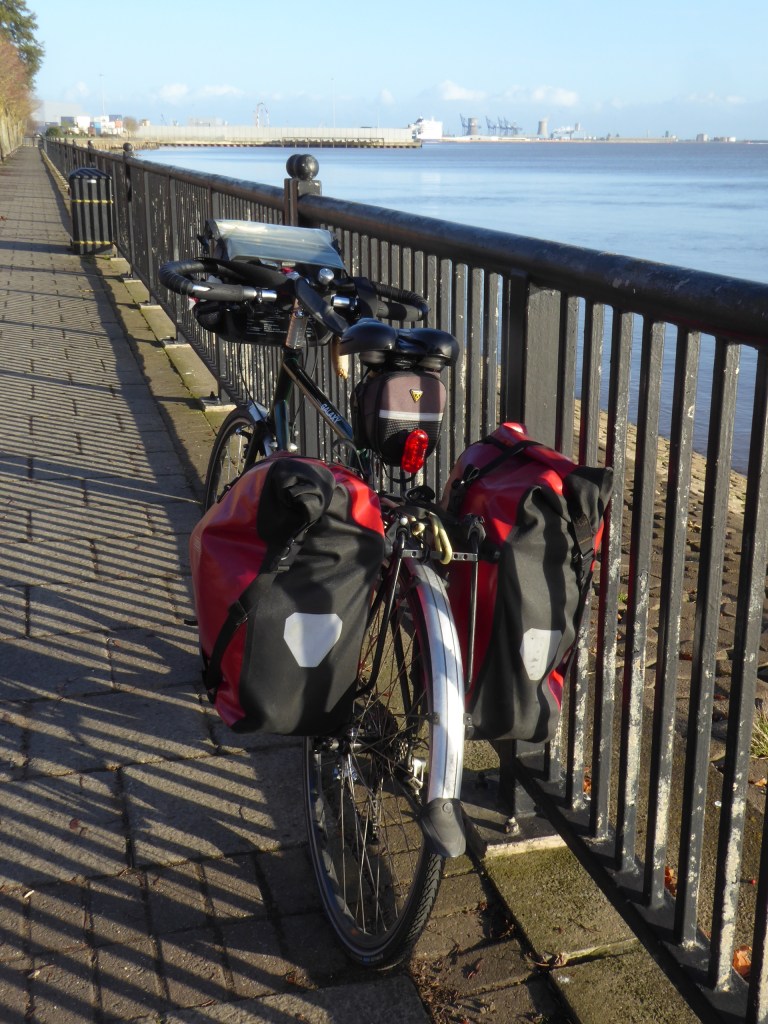
Humber estuary and the ferry in the background

So: things that may go wrong. Well, weather of course. Mechanical or physical failure. The rear wheel came loose as I got off the train at Hull. I fixed that, but it did make me very careful cycling to the port. Cancellation of the Dutch and/or German trains I’m booked on, but there are alternatives. Difficulty in finding hotels – but I can adapt my route to suit.

I may as well just enjoy myself.

Jean Rhys

I’ve had a blitz on Jean Rhys. Not “Wild Sargasso Sea” but her collected short stories and her interwar novels: “Quartet”, “After Leaving Mr Mackenzie” and “Good Morning, Midnight”. It was reading Ford Madox Ford that prompted me.

The narrative voice in the novels doesn’t vary much and really does qualify for its own term, “Rhysian”. Despite ranging from the Caribbean to Vienna via Paris and London (Tottenham Court Road is a landmark), her world is quite small. Even Jane Austen’s “little piece of ivory” exceeds Rhys’s. She’s very insightful on being English but (having grown up in Dominica) not being seen as English by the English. She is an eternal, rejected outsider. The events of these stories – or a version of them – largely happened to Rhys, but the narratives are viewed through an increasing detached authorial lens. A woman – or, rather, three separate women – moves further and further into a spiral of drink, grotty hotel rooms and men to support her.

With decreasing success. I highlighted all of this passage just to remember the flavour of her stark prose.

We cross the road unsteadily and stand under a sickly town-tree waiting to signal a taxi. I start to giggle. He runs his hand up and down my arm.

I say: ‘Do you know what’s really the matter with me? I’m hungry. I’ve had hardly anything to eat for three weeks.’

‘Comment?’ he says, snatching his hand. ‘What’s this you’re relating?’

‘C’est vrai,’ I say, giggling still more loudly. ‘It’s quite true. I’ve had nothing to eat for three weeks.’ (Exaggerating, as usual.)

At this moment a taxi draws up. Without a word he gets into it, bangs the door and drives off, leaving me standing there on the pavement.

And did I mind? Not at all, not at all. If you think I minded, then you’ve never lived like that, plunged in a dream, when all the faces are masks and only the trees are alive and you can almost see the strings that are pulling the puppets. Close-up of human nature – isn’t it worth something?

l expect that man thought Fate was conspiring against him – what with his girl’s shoes and me wanting food. But there you are, if you’re determined to get people on the cheap, you shouldn’t be so surprised when they pitch you their own little story of misery sometimes.

*

In the middle of the night you wake up. You start to cry. What’s happening to me? Oh, my life, oh, my youth . . .

There’s some wine left in the bottle. You drink it. The clock ticks. Sleep . . .

That’s fairly typical, I think. Downbeat, sordid, melancholy, cynical – but so fascinating. Vulnerable and razor-sharp at the same time: you wonder how long it took – and how many tears were shed – for Rhys to hone that edge.

And now I want to go to Paris (and think of Tottenham Court Road while walking down the rue de Rennes)!

Paris, Texas (1984)

Director Wim Wenders with Harry Dean Stanton and Nastassja Kinski

When this came out someone told me that it was the best film they’d ever seen so I confess I was expecting something more. It had that all-encompassing and all-forgiving humanity that I associate with Wenders’ films, but perhaps it hasn’t aged well. For me the plot didn’t live up to the cinematography – or maybe I couldn’t overlook the fact that the behaviour Travis tries to atone for has its own section in the Crime Act nowadays under “coercive control”.

It’s filmed in a way that invites you to consider and analyse it: unusual views, long shots, the foreignness of the US despite its on-screen familiarity. I was transfixed by the view of aeroplanes flying below Walt and Anne’s house in Los Angeles. (Thoughts of the house in “Double Indemnity” – was that on the same hill?) The restlessness of the shots of roads, runways, paths. Driving, flying, walking. Always moving on in search of something. Landscapes natural and urban. The opening of a man walking through the desert was straight out of a western, but his last drops of water (a western cliche if ever there was one) came from a plastic bottle rather than a battered canteen. Lots of touches of red: baseball cap, shirts, the car that Jane drives.

Mirroring: two brothers, two wives, one child. One mother loses and one gains, and not even Solomon could solve that. The beginning and the end of a man on the move. The reflections in the one-way peep-show glass as Travis and Jane talk to each other without ever seeing each other clearly or touching. The title: the place of Travis’s beginning, the place where he had hoped to settle his family, and the increasing unkind joke of his father about his mother – more mirroring of deteriorating marriages.

So, yes, it kept my attention, but, on this occasion, its parts were greater than its whole.

Ruddigore

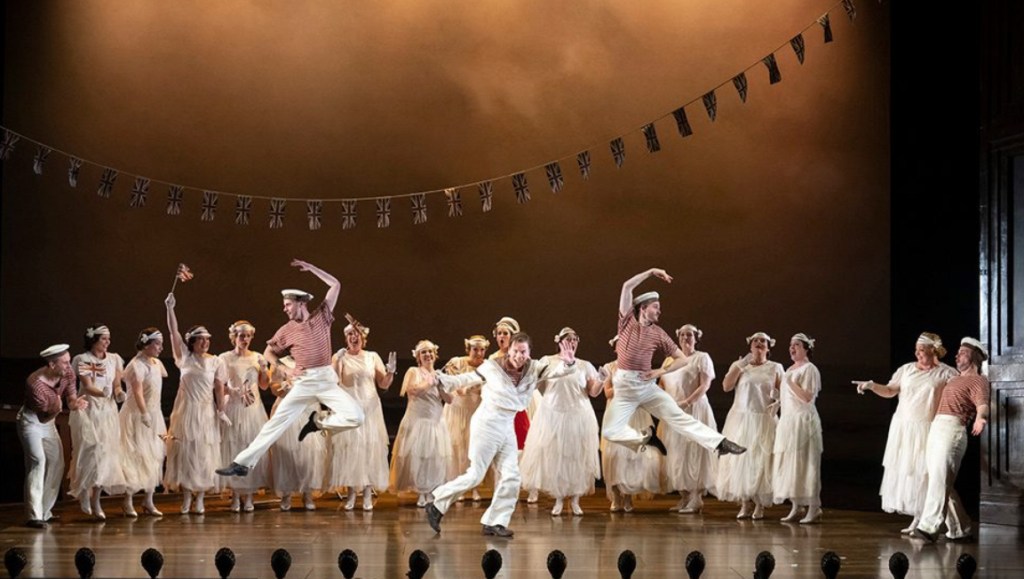
I’ve never seen a Gilbert & Sullivan opera before. Great fun and brilliantly staged. I managed to get to the pre-show talk this time, where I learned that it satirised “transpontine melodrama” – and, here, the bridge was the one over the Thames. So “south of the river” has a long reputation for being infra dig.

Even by the standards of opera, the characters were caricatures. The only moment of real feeling (besides mirth) was in a pretty, sentimental duet – “There grew a little flower” – between an elderly maiden and a ghost. I came out still humming the bridesmaids’ song.

  • Sir Ruthven – Dominic Sedgwick
  • Rose Maybud – Amy Freston
  • Richard Dauntless – Xavier Hetherington

A Midsummer’s Night Dream

I mistimed this one. I knew nothing about the opera before I went – not even the composer (Britten) – and was going to rely on the pre-show talk to fill me in. So I prepared to set off for the 6 p.m. start of the talk . . . and discovered that it had started at 5 p.m. The opera itself started at 6 p.m.

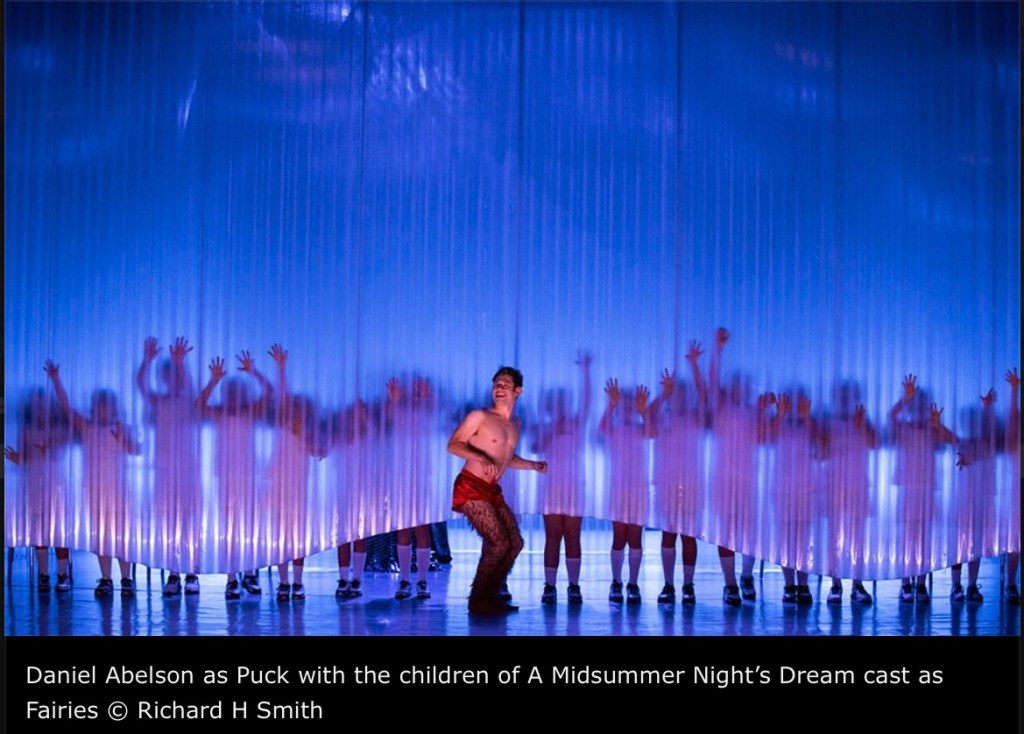
So I went in unprepared. Not that it mattered – and, besides, we’d “done” the play in school (O-level perhaps) and some lines, memorised for exams, called back to me across the decades. The early start, I’m guessing, was for the sake of the slightly creepy fairies – average age 10, working hard on a school night.

It was good. Unusual choices (Oberon was written for a counter-tenor, the wood was represented by sheets of perspex) and a sixties setting. The music introduced me to tone painting and started eerily. Non-singing Puck was very good – shades of Gollum or even Mutley – but somehow the sense of the physical world reflecting fairy discord was lacking.

I liked the thought that its premier was in the Jubilee Hall, Aldeburgh. La Scala, eat your heart out.

  • Oberon – James Laing
  • Tytania – Daisy Brown

The Lady of Shalott

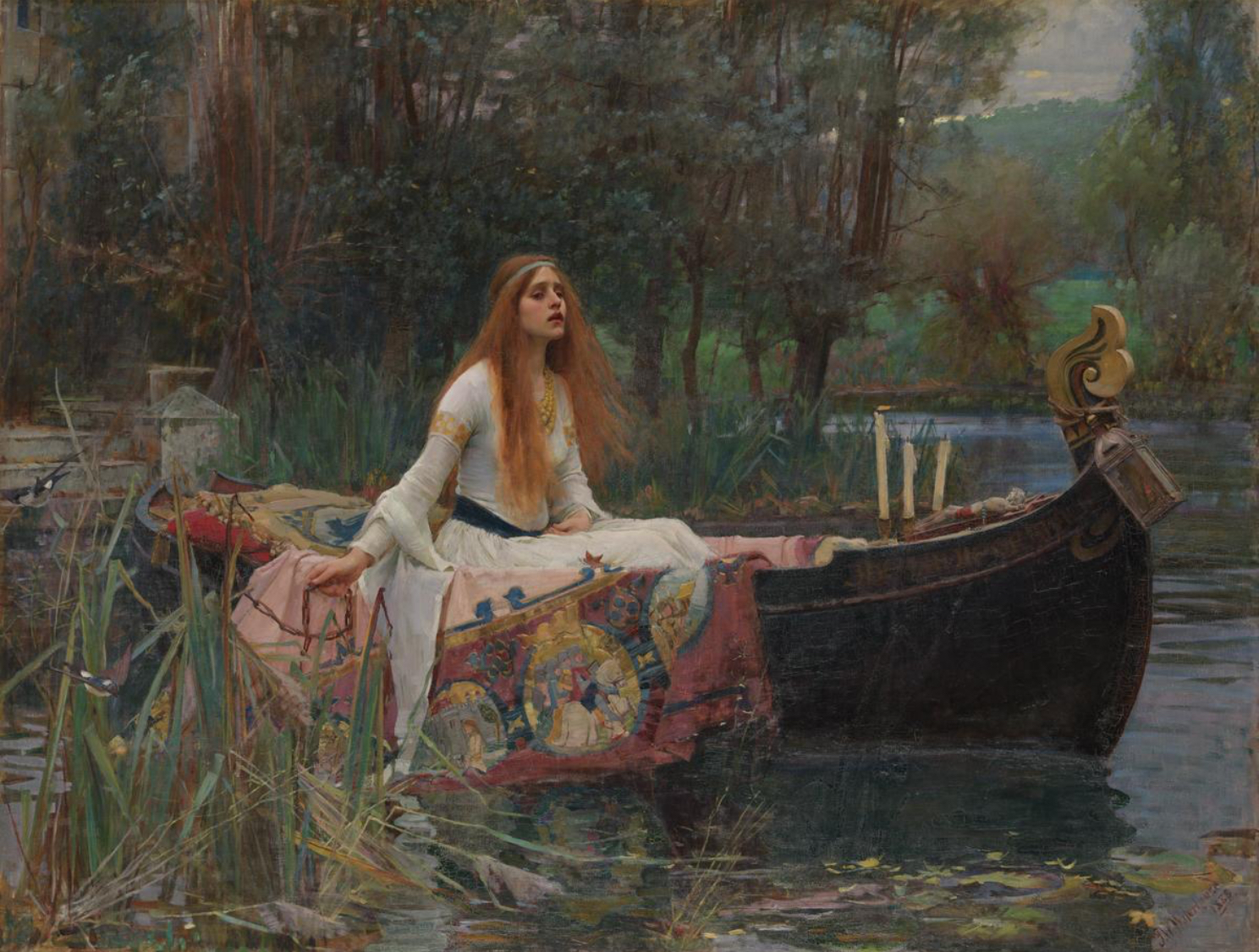
Goodness, how the Victorians loved the Arthurian legends. I really can’t be bothered to speculate why they were so drawn to the image of a trapped, cursed woman, so I shall just admire the paintings.

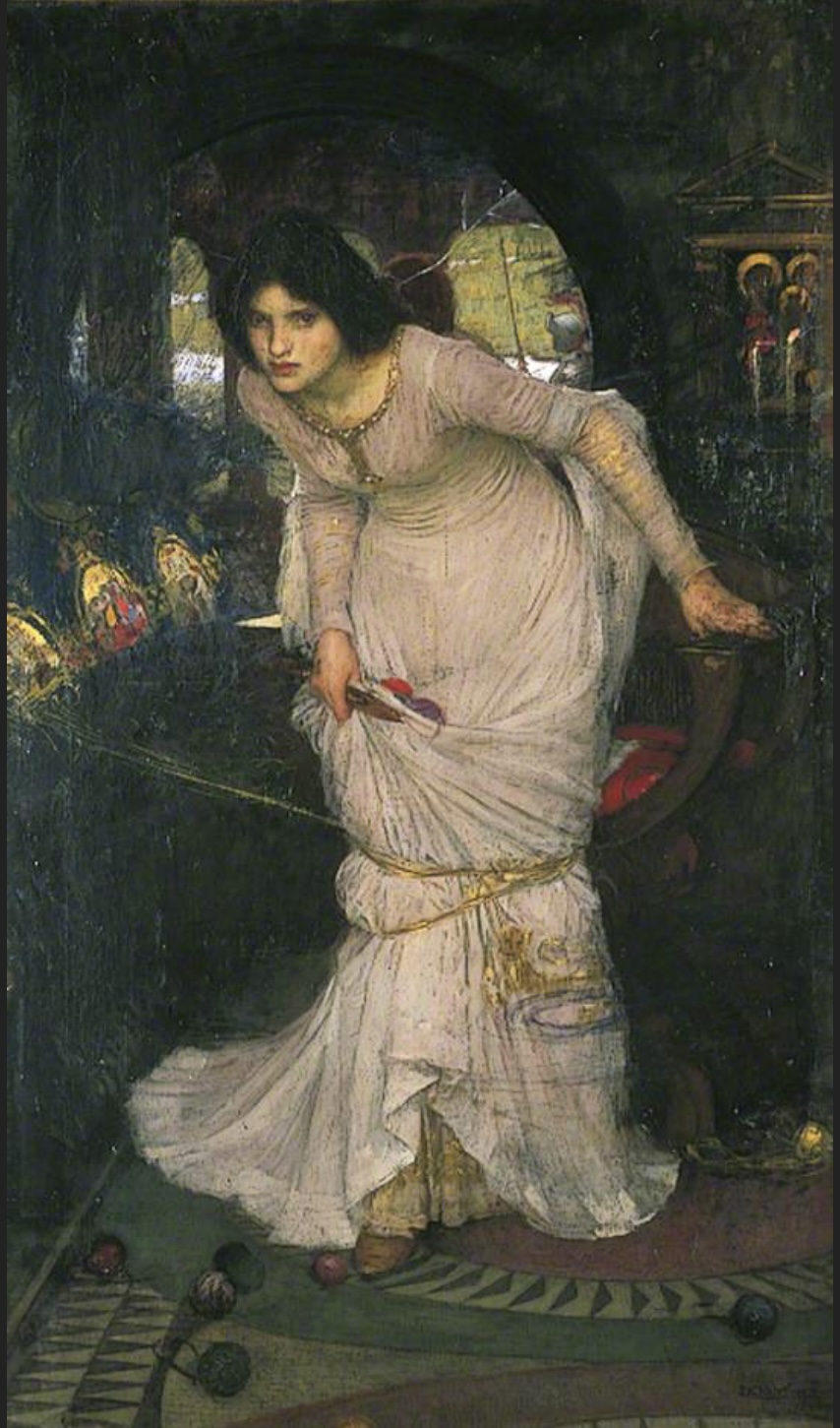
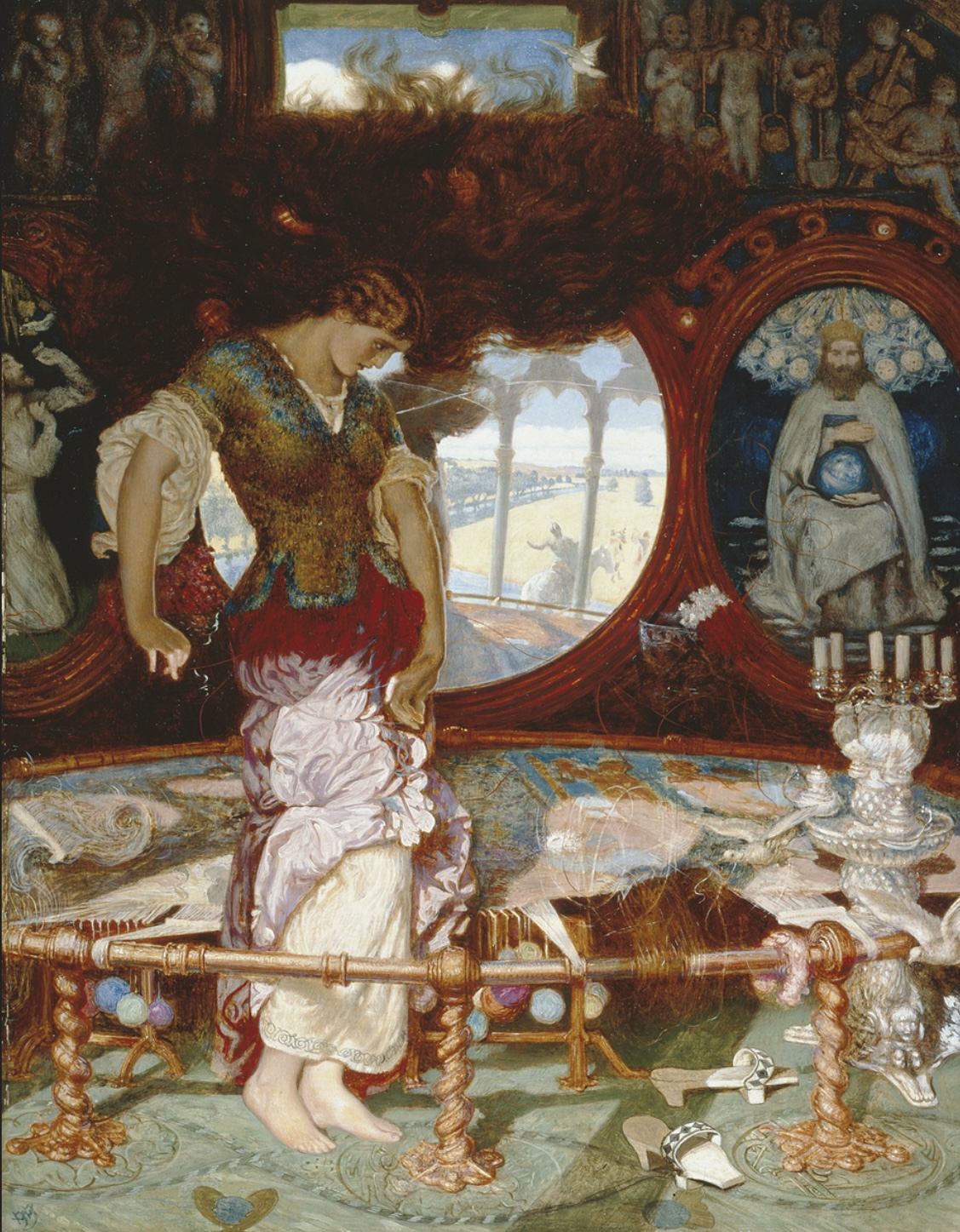
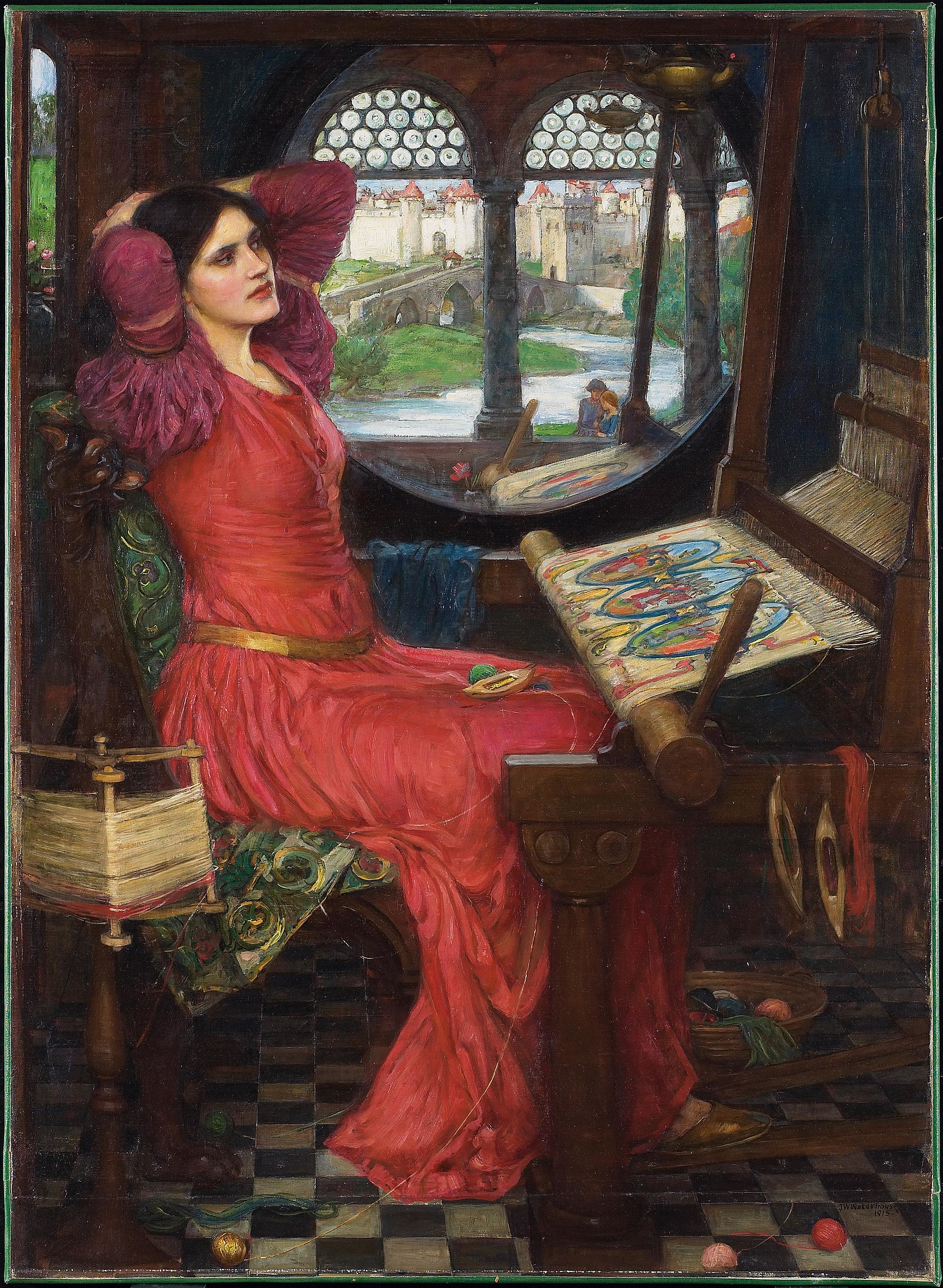
Today I was in Leeds art gallery and looked again at Waterhouse’s entangled lady. (I’m always bothered by the blue squiggle on her white dress. I assume it’s the thread unravelling, but it just looks like a biro scribble.) Two weeks ago it was Holman Hunt’s pirouetting lady in Manchester art gallery. And at the back of my mind she is always the lady from “the broad stream bore her far away” reproduction in my Arthur Mee. (I will get round to looking through the volumes again to check the illustrations I think I remember.)

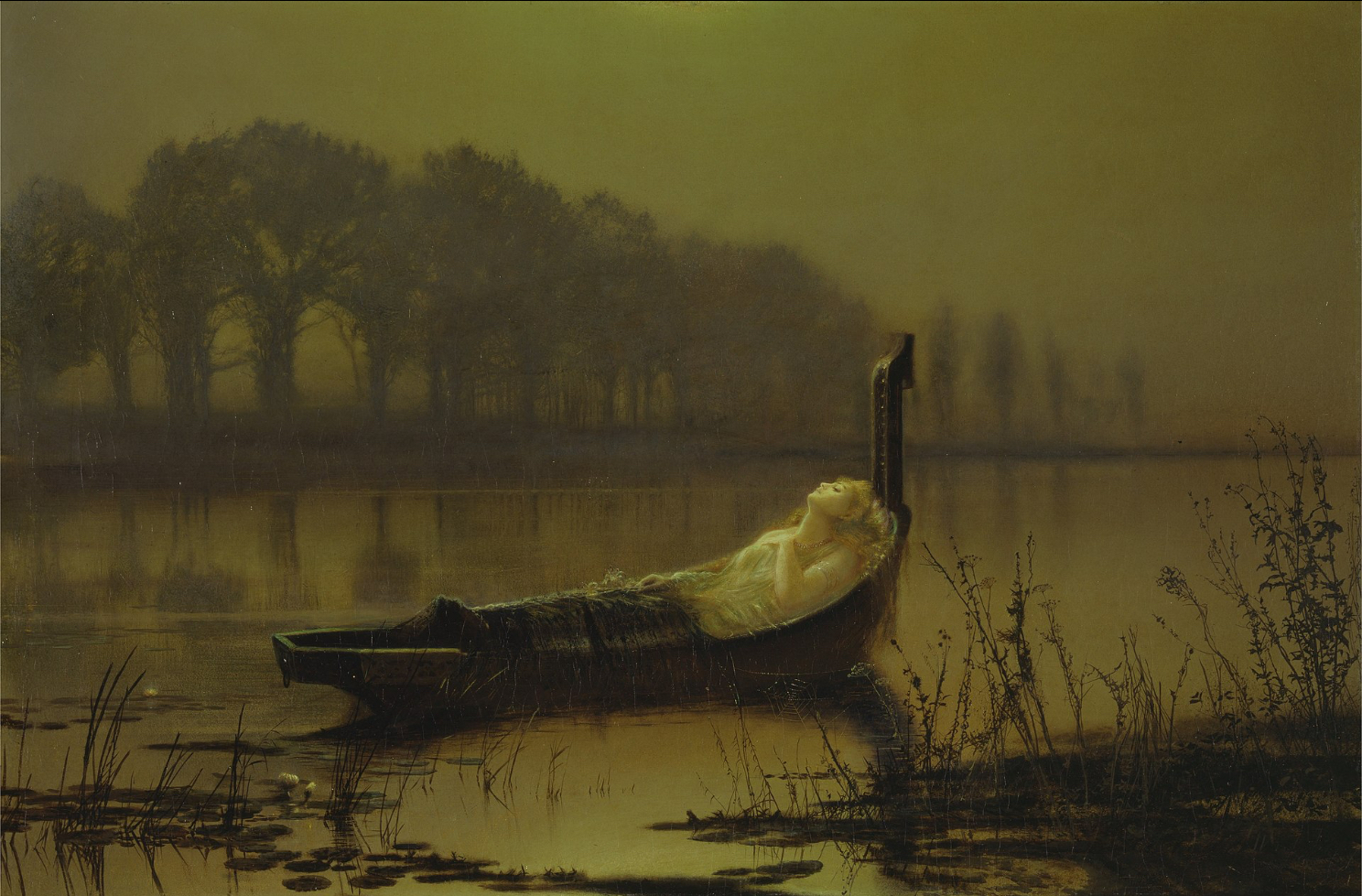
While roaming online, I discovered that Tennyson wrote two versions of his poem (1832 and 1842), that Waterhouse painted yet another version, and that Atkinson Grimshaw also painted the lady. Which confirms that he really couldn’t do figures!