Hamnet

Director Chloé Zhao with Jessie Buckley and Paul Mescal

I have a prejudice towards films about real people: it seems to me a trespass and condescension to assume you can portray the inner life of another person. It’s a bit ridiculous of me, and I frequently put it aside (quick check to see how many biographical films I have watched over the past couple of years). And – be reasonable – it’s not like everyone has the option to make autobiographical films like The Long Day Closes. Besides – Hamnet is a film with William Shakespeare, who surely sent Richard III spinning in his grave(s), and so little is known of his life – not to mention his wife’s – that there is fertile ground for speculation.

I enjoyed Zhao’s last film, and there were continuities with this one: strong female lead, nature, joy, kindness, hardship, dirt, earth. Agnes barely moves horizontally in this film (just once to London); her plane is vertical, from planting in the ground with her bare hands to soaring with her hawk. It’s a powerful film: I was a bit resistant to the obvious emotional wave of the acting and musical score at its height but it was undeniable. The attraction between Agnes and Will is immediate and practically wordless; of the two, she has the greater power of the spoken word with rhymes and chants learned from her mother and her own self-expression. The “great man” is often peripheral to the story, for this is seen through women’s eyes: Agnes and her mother-in-law are the protagonists here. (Lots of incidental ironies: if this had been made in Shakespeare’s time, they would have been played by men.) The modern dialogue and sensibility (which jarred slightly) are offset by the dirt and hardship of sixteenth-century life. Birth and death were definitely not anaesthetised or antiseptic.

I am ambivalent about it. My critical voice was on speakerphone while I watched it, telling me that it was too obvious in its emotional weight – but, on reflection, the themes of a woman’s life, family life, nature (the basics of any life, after all) and the transmutation of love and grief into a shared experience through art have stayed with me.

London

I arrived in London early and headed to Walthamstow to the William Morris Gallery for an exhibition of Liberty fabrics by women designers. There were some lovely fabrics – thankfully not all of them florals – and it was interesting to see the changing fashions over the decades. I already had a soft spot for Lucienne Day’s designs, and here I added Althea McNish, Gwenfred Jarvis, Hilda Durkin and Colleen Farr.

Arthur Liberty founded the shop in 1875, initially importing textiles and objets d’art from Asia and the Middle East. It soon moved into designing its own fabrics and helped to popularise the new Arts and Crafts and art nouveau styles. The fabrics were all printed until 1972 at the Merton Abbey Mills, and there was some fascinating film of the designs being block- or screen-printed and then rinsed in the chalk stream by men in their shirt sleeves who had been doing that work for decades. Then came the finished garment – which no doubt cost an arm and a leg to buy. A fascinating bit of social and economic history: design opportunities for talented women (initially anonymous), manufacturing work for local companies, then the sale of the finished goods to the prosperous to adorn their homes and persons – much of that exchange also transacted between women, albeit across a social divide.

After lunch I managed to get the last ticket of the day for the Secret Maps exhibition at the British Library. (It’s the final week of the exhibition, so I was lucky.) It was good at showing the power of maps – particularly at times of war or rivalry. The Dutch East India Company tried to keep secret their world map of 1648, which showed part of the coast of Australia. Even before that, the c 1547-produced map for Henri II showed the outline of a great southern continent. Hand-drawn maps were safer, in terms of reproduction, than engraved maps. Armed or a defenceless locations could be removed from or disguised on maps (at least before aerial photography). Tiny maps or maps printed on materials like silk could be hidden (and worn). There was a wonderful hand-drawn map by T E Lawrence of his route from the Red Sea coast to the Hejaz railway. Clandestine maps of worldwide cable networks, or the chart of radio beans on the Normandy coast to assist the D-Day landings (which later influenced GPS).

The unconsidered power of maps was also revealed – as in the official map of Nairobi, which shows no sign of the vast Kibera informal settlement of perhaps 170,000 people. New rulers give new names to their colonies and territories and divide them as they wish. Certain areas/transport corridors are prioritised over others. (I note how this hierarchy is reversed when I use bike route maps: main roads are uncoloured but the route I want is a bright red line across the page.) People have not always wanted their areas to be mapped – preferring to remain under the official radar or fearing what easily accessible knowledge may bring to their land.

More personal maps: the 1930s London map which showed public toilets that were used as meeting places for gay men. Charles Booth’s 1889 map of London which marked each street on a poverty-prosperity scale. Then came GPS and all the data which can be gathered (as in the routes run by American soldiers using Strava that gave away locations of their bases in Afghanistan ) or routes that can be used by asylum seekers to cross vast distances with an encryption messaging app.

I’m glad I got the last space.

Seven Samurai (1954)

Director Akira Kurosawa

An engrossing film – despite its lasting three and a half hours and my knowing the story from The Magnificent Seven. B&W with some scene transitions that made me think (incongruously) of the 1960s Batman series. I don’t know how much the director had westerns in mind as he filmed it, but inevitably westerns were constantly in my mind as I watched it. The social types, the codes of honour, the paucity of female roles, the dress code. Quite fascinating.

Strong opposites: the peasants frightened, sly and eternal, a collective; the samurai brave, mobile and ephemeral, for they would die before their time. The bandits – ? Landless peasants, rogue samurai or just generic “baddies”? There were speeches about the importance of collective over individual defensive action, and I wondered if the film (expensive, long, prestigious) was aimed at bolstering Japan’s image after its surrender.

It made me rethink Hollywood genres and tropes too. Not just westerns but all those Robin Hood type of films and the Roman/early Christian films I saw on television as a child, which inducted me unwittingly into the “grammar” of the genres so that I know that a black cowboy shirt indicates a baddy without ever having learned the fact. I couldn’t parse the significance of sumo-style wrapping vs long culottes for samurai in the same way, but I’m not sure it mattered. There were only three guns – all in bandits’ hands at the outset – and I wondered if these foreign imports were viewed as somehow dishonourable. There was definitely an elegiac quality in the depiction of the samurai – as if their day was coming to an end.

Yes, I’m glad that I have watched this particular classic.

It Was Just An Accident

Director Jafar Panahi

Set in Iran and filmed without official permission. A family man accidentally runs over a dog (“just an accident”) and damages his car. While it is being repaired, he is seen by a car mechanic, who believes he recognises him as the man who tortured him in prison some years before. He kidnaps the interrogator and intends to kill him, but doubts creep in: is he mistaken in his identification? He never saw the man, for he was always blindfolded. He knows only the voice, the smell and the sound made by the prosthetic leg – experiences he can never forget. Over the course of a day and a night he drives around with other past victims of the interrogator as they try to decide what to do with him.

It’s a tense, varied film – sometimes almost comic, sometimes almost disquisitional, frequently chilling. It implies that there is no end in sight to the violence: the trauma and suffering of the regime’s victims against the sense of righteousness of the regime’s officials. There is kindness and goodness, but also fanaticism, a desire for revenge and a generalised corruption (e.g. security guards with their own card readers for backhanders). It was quite brilliant – and the ending caught me off-guard.

Politics

Not much point in borrowing a big book on politics and not trying to remember something of what I have read!

But first: what type of big book on politics? I borrowed two: one (1967) on the essential writings of Karl Marx, and another, “The Politics Book” (2024). The difference in presentation was quite something. I couldn’t face the dense text and the unknown concepts of the first so stuck with the picture book. (It’s not like I wanted to know everything – just a bit more than I already did up to the start of the twentieth century.) The picture book focused on thinkers to present different political approaches/ideologies. I’m not sure how some of them made the cut: Nietzsche but not Napoleon. There are vast gulfs too in many of the stances: Gandhi (“Non-violence is the first article of my faith.”) or Mao (“Political power grows out of the barrel of a gun.”).

It’s been interesting to see the proliferation and increasing complexity of ideas over the centuries, responding to industrialisation, colonialism, increasing secularisation, the idea of universal rights – not to mention revolutions and wars of independence, and of the rising importance of economic maintenance. Also different emphases – on whether human nature is predominantly self-interested or co-operative; nation state or federation; political moralism, realism or pragmatism?

Confucianism – rule by benevolent, wise king supported by loyal ministers who advise him and have the interests of his subjects at heart. A moral king sets a good example, which will filter down to the populace. Hierarchy is flexible – ministerial positions open to those of ability and good character. Reciprocity in relationships. Confucius lived mid-6th century BCE, at the end of the peaceful Spring and Autumn period, and his vision of how to administer an empire was more suited to peacetime than the Warring States period (476-221 BCE). Legalism – authoritarian and pragmatic – prevailed until the establishment of the new empire under the Han dynasty, when Confucianism was adopted as the state philosophy.

Sun Tzu – contemporaneous with Confucius – and The Art of War. The importance of maintaining strong defences and strategic alliances. The leader as a moral example who can command loyalty. War as a last resort.

Plato and the Republic – 5th-century Athens. The art of living well/virtuously (eudaimonia) is only fully understood by philosophers: politicians are interested in wealth and power and at best only imitate virtue, whereas a philosopher has studied and truly understands a virtuous/good life. If you can’t make a philosopher king, then you must make the king a philosopher.

Aristotle (384-322 BCE). Focus on empirical evidence rather than the intellectual reasoning of Plato. Man is a social animal; it is unnatural for him not to live in a polis. The polis or state exists to enable men to lead a good/virtuous life, and the form of government affects this aim. Three forms of government and their “corrupt” versions: monarchy/tyranny (i.e. defective monarchy); aristocracy/oligarchy and polity/democracy. Aristotle favoured polity – the rule by many for the benefit of all – over democracy. His works – more lecture notes than books – barely featured in western Europe between 600 and 1100 and were better known in the Arabic and Byzantine worlds. Thereafter his works were translated into Latin from Greek and Arabic and more widely read.

The Roman republic spread power through a mixed constitution – Consuls, Senate, popular assembly – which provided checks and balances until it was replaced by the empire (and its succession of ever-more-bizarre rulers).

Monotheistic religions, once they gained power, introduced the divine into politics. Augustine of Hippo and the division between civitas Dei and civitas terrea, and the concept of the just war. Muhammad, while extolling peace, spread Islam through conquest. Al-Farabi (c 900) was influenced by Plato, but replaced his philosopher king with a philosopher prophet/a just imam. The Virtuous City however remains a myth: citizens prefer earthly pleasures and reject a virtuous ruler.

Thomas Aquinas (13th century) married Christianity and Aristotelian logic: human reason can provide arguments for the existence of God. His political insight was that a war is just if it has a just cause and is conducted in accordance with reasoned notions of justice. “Natural law” is inherent, determined by reason, and aligns with God’s law; “human laws” are those rationally-based ones that we apply to ensure the smooth running of society.

Marsilius of Padua (1275-1343) – writing at a time of one of those power struggles between the Pope and the Holy Roman Emperor – stated that the Church – i.e. the papacy – should not have political power. An early version of secularism.

I was rather taken with Ibn Khaldun (1332-1406), who seems to argue from observation rather than theory. “Government prevents injustice, other than such that it commits itself”. He acknowledged the dynamism of government: it begins with natural social cohesion, then expands into government for the well-being of the governed, but morphs into the domination of the ruling class and the exploitation of the governed.

And so we come to Niccolò Machiavelli (1469-1527) with his espousal of pragmatism and ditching of any religious ideals. Human beings are a malleable bunch: we are self-centred and fickle, but we are also imitative and can be persuaded to act benevolently and co-operatively under an effective leader. Social organisation is key; the ruler’s morality is secondary to state security and utility. Political life is a constant battle, and its weapons are secrecy, intrigue and deceit. (No wonder Machiavelli has a bad press, but he did not condone these methods in private life.) This approach applies where there is a sole ruler – a monarch or “The Prince” of Machiavelli’s treatise – but a republic (perhaps introduced by exactly that deceit and intrigue that he condoned) would operate differently. At this point it’s worth noting the turbulent times that Machiavelli lived through. Peace and stability at any price might have been worth it.

Europeans’ brutal exploitation of the Americas and criticism by the School of Salamanca. Francisco di Vitoria (first half of the 16th century) stressed the principle of natural law: we all share the same nature and therefore have the same rights. Religion was not a just cause for war. Francisco Suarez (second half of 16C) – sorted laws into natural, divine and human; no human-made law (positive law) should override people’s natural rights to life and liberty.

This move away from divine or natural law towards individual liberty and rights was extended by Hugo Grotius (1583-1645): people have rights to life and property and the state has no right to take them away.

Consociation: Johannes Althusius (1557-1637), Calvinist political philosopher. Human communities come into being through a kind of social contract. Like Aristotle, Althusius stressed the sociability of humans. Individual communities are subservient to the state, but collectively they are superior to the state. Federalism, but one that is less individual-based than in the present day.

Sidelining of ideas of divine law with the rise of the modern scientific method and empiricism; greater stress on the idea of human nature untethered from social structures. How did people actually behave? Thomas Hobbes (1588-1679 – so he lived through the English Civil War) and his pessimistic view of human nature. Without strong government, people would live in a state of perpetual wrangling, each individual self-interested and anarchic (the “solitary, poor, nasty, brutish and short” scenario). Therefore strong government is essential, and individuals submit to it under a form of social contract for the sake of the safety and rule of law that it promises. The sovereign is absolute so long as he guarantees the safety of the people.

John Locke (1632-1704): liberalism. Continued the idea of the social contract, but government should have a limited role. Its task is to protect citizens’ rights to life, freedom and property, and Locke held it acceptable to rebel against illegitimate government.

Montesquieu (1689-1755) argued for separation of powers: an executive branch for enforcing law, a legislative branch for passing and amending laws, and a judicial branch for interpreting laws. This would avoid despotism and create a stable government; the idea became influential in the creation of the United States constitution (1787) and in France after the revolution.

Jean-Jacques Rousseau (1712-1778). Unlike Hobbes, Rousseau believed that, free of state control, man in a state of nature, is actually a happy and contented creature. The social contract trammels him, but government is not set in stone. Under a new type of social contract man could be free and content again within the bounds of new laws and a society could even become perfectible. Sovereignty comes from the people (the general will), not the ruler – via popular assemblies, though, rather than modern democracy.

Edmund Burke (1729-1797) anti-Rousseau and a Whig, he favoured gradual progress in society, not an abrupt break – e.g. the French Revolution, whose outcome horrified him, whereas the 1688 “Glorious Revolution” was acceptable because it restored order to the country. He was also in favour of American independence. He thought that discussion of abstract rights distracted from the job of government, which is to administer the country. Passions of the individual should be subjected to the laws of the country to ensure the fairest outcome.

Thomas Paine (1739-1809) was one of the first to propose democracy in the form of universal male suffrage with no property qualification. Highly critical of the corruption and inadequacy of the British Parliament of that time. Voting is the way for society to shape a government that reflects social needs. Monarchy and other hereditary principles are unnatural. and can lead to despotism. Like Burke (once his friend), Paine was a strong supporter of the rights of American colonists to independence – but also of the French revolution. (He avoided execution there.) He followed Rousseau’s idea that the general will of the people should be sovereign in a nation and believed that, with fair elections, private interests and corrupt practices would wither away. Reflected in the American Declaration of Independence and its insistence on inalienable rights.

Enlightenment thought with its emphasis on reason was challenged by Johann Gottfried Herder (1744-1803), who held that a person’s shared cultural and linguistic background shapes character. A cultural nation with its own Volksgeist was where man was happiest. His ideas were influential to the rise of Romanticism and the 19th-century development of new nation states (Belgium, Greece).

Jeremy Bentham (1748-1832) and utilitarianism: the greatest good to the greatest number of people is the measure of right and wrong. A government’s task is to decide which laws are likely to produce more universal good than harm. Bentham devised the felicific calculus to work out this problem. 
In favour of universal suffrage – not from the perspective of natural rights but as a pragmatic way of ensuring that only a government that increased general human happiness for the greatest number would triumph.

Mary Wollstonecraft (1759-1797) – A Vindication of the Rights of Woman. Without education, women cannot earn their own living. They are therefore dependent on men for financial support and must do what they can to catch a husband. Respectable women who do not play this game are eternally at a disadvantage.

Simón Bolívar (1783-1830) – rejecting power of the Spanish in South American countries. Small republics should replace colonies: a small republic is self-contained, has no reason to expand its boundaries and therefore is a stable and just state, whereas a monarchy or an empire is constantly trying to conquer other lands. Behind the liberation of Ecuador, Colombia, Venezuela, northern Peru and NW Brazil.

Carl von Klausewitz (1780-1831) – “war is a continuation of politik by other means”, by which he meant that war is a serious act of one state imposing itself on another and must have an overriding political goal.

Auguste Comte (1798-1857) – French positivist philosopher: understanding society requires valid data from the senses, followed by the logical analysis of this data. Society operates according to laws, just like the physical world of natural science, and the family – not the individual – is the true social unit. “Families become tribes and tribes become nations.
“

Alexis de Tocqueville (1805-1859) argued for a return to the ideals of the French Revolution. He wanted a democratic, free, classless France and rejected socialism. His saw socialism as promoting materialism, bypassing the highest human virtues, undermining the principle of private property (which he saw as vital to liberty), and stifling the individual.

The rise of the nation state in the 19th century. Giuseppe Mazzini (1805-1872). Individual rights and interests are not a good enough basis to govern a society. People need to work together within their country (created by God) as an association, a brotherhood, for the common good.

John Stuart Mill combined Bentham’s utilitarianism with individual liberty in liberalism. He thought that people should be free to think and act as they wish so long as they don’t harm anybody else. 
The “tyranny of the majority” can bring conformity and stagnation; eccentricity was the mark of a dynamic society, where there would be a profusion of ideas that could be tested in the “bubbling cauldron” of public opinion.

Pierre-Joseph Proudhon (1809-1865) and the idea that “property is theft”. Rights to liberty, equality, and security were the basis of society, but the right to property was not in the same league. Property, in fact, undermined those rights because it enshrined liberty for the rich and perpetuated poverty for the poor.
Mikhail Bakunin (1814-1876). The only authority to acknowledge is the laws of nature. They are the only constraints on us. We should rebel against the authorities of religion and government. Anarchism is the path to human freedom and human liberation.
Henry David Thoreau (1817-1862). People – citizens – must do what their moral conscience tells them is right, even if it means rebelling against the government or engaging in civil disobedience. By being passive, citizens may find themselves colluding with injustices that they would otherwise condemn, like slavery.

Karl Marx (1818-1883) – his analysis of 19th century industrial capitalism and his theory that material and economic factors influence historical developments (the dialectic). His theory rested on its internal logic more than sociological observation (although there was Engels). Production of goods essential for human life can be organised in different ways; the way that they’re organised gives rise to different kinds of social and political arrangements. Man needs to work to provide himself with certain goods, but work also has the potential to be intensely fulfilling. Under the Victorian industrial capitalist system, though, workers are alienated from what they produce. Instead of creating the products that they themselves use, they create them partially and en masse for an employer for wages. Hence they sell their labour, which becomes just another commodity. 
This alienates them from their true nature – creative, sociable – and from their fellow workers. 


Friedrich Nietzsche (1844-1900) developed Schopenhauer’s notion of will to survive as a “will to power” – a no-holds-barred striving to higher values. He presented this Übermensch as the successor to the deities of organised religion.

Georges Sorel (1847-1922) sounds a bit incoherent. Political structures in the 19th century were changing fast in the wake of industrialisation and population movements. Sorel believed that parliamentary democracy failed the working class and benefitted the middle class. 
What the working class needs are myths to believe in, and violence is a way of actualising these myths. At first he supported syndicalism – the most militant wing of the trade union movement which favoured strikes over political manoeuvering – but by the end of his life he seems to have tasted just about any political theory

Eduard Bernstein (1850-1932) was a member of the German Social Democratic Party, which was guided by Marxism. Bernstein noticed that Marx’s predictions weren’t happening: workers were not moving towards revolution. In fact, they seemed to value the stability and security of capitalism. He therefore proposed ditching the idea of revolution and accept that socialists look at what workers actually believed and work on that – gradual rather than revolutionary socialism. (The Social Democratic Party formally renounced Marxism in 1959.)

(This is particularly relevant since I’m re reading this on the day that Trump has removed the Venezuelan president.) José Martí (1853-1895) Latin and South American countries had mostly thrown off European shackles, but Martí warned of colonialism of a new kind from the United States. The Monroe Doctrine of 1823 affirmed that the United States remained opposed to European colonialism, but it also identified both North and South America as falling under the “protection” of the United States.

Peter Kropotkin (1842-1921) and anarcho-communism. He argued that the best aspect of humanity is its ability to co-operate; this would allow it to do away with all oppressive structures; a new society could be based on mutual respect and collaboration.

Sun Yat-Sen (1866-1925), Chinese nationalist, hostile to the weak and corrupt imperial court. He stressed the strength of Chinese culture and wanted to fuse China’s traditions with “Western” development. He laid down the Three Principles of the People: nationalism, democracy and people’s economic improvement on the basis of fair distribution of China’s resources
. The Qing dynasty was overthrown in 1911 and Sun was briefly president in the new Republic of China.

There’s also the whole history of twentieth-century decolonisation and newly independent states which I’m trying to get my head round. Not just the new political structures but also the absence of a contemporary home-grown model of government.

And the point we are at now? A global plate-spinning exercise. On the one hand powerful elites – business, military, key politicians – run the institutions which provide us with what we expect in our prosperous western world. It’s hard to see how they can be reformed without serious economic consequences. On the other – I’m thinking of Michel Foucault’s notion that the power of the state is diffused through “micro-sites” like schools, workplaces and families (which have always existed), but that’s more of an incidental thought.

Bird walk

It’s been too cold recently to want to go for a walk but too sunny not to feel around 2.30 p.m. that I’ve wasted the day. So I caught the bus and walked back along the estuary, grumbling to myself about the cold wind. The tide was high. Lots of widgeon, herons and egrets, curlews in a field and – on the wonderfully etched mudflats – lapwings and (I think) dunlin. The dunlin made the lapwings look enormous, and the lapwings made the curlews look gigantic. As for the herons . . .

Staveley to Kendal II

This time I set off north from Staveley rather than south, via Potter Tarn and the River Kent. It was a cold, grey, windless day; mercifully it has been dry for over a week, so there was no slippery mud to contend with on the up/downhill sections.

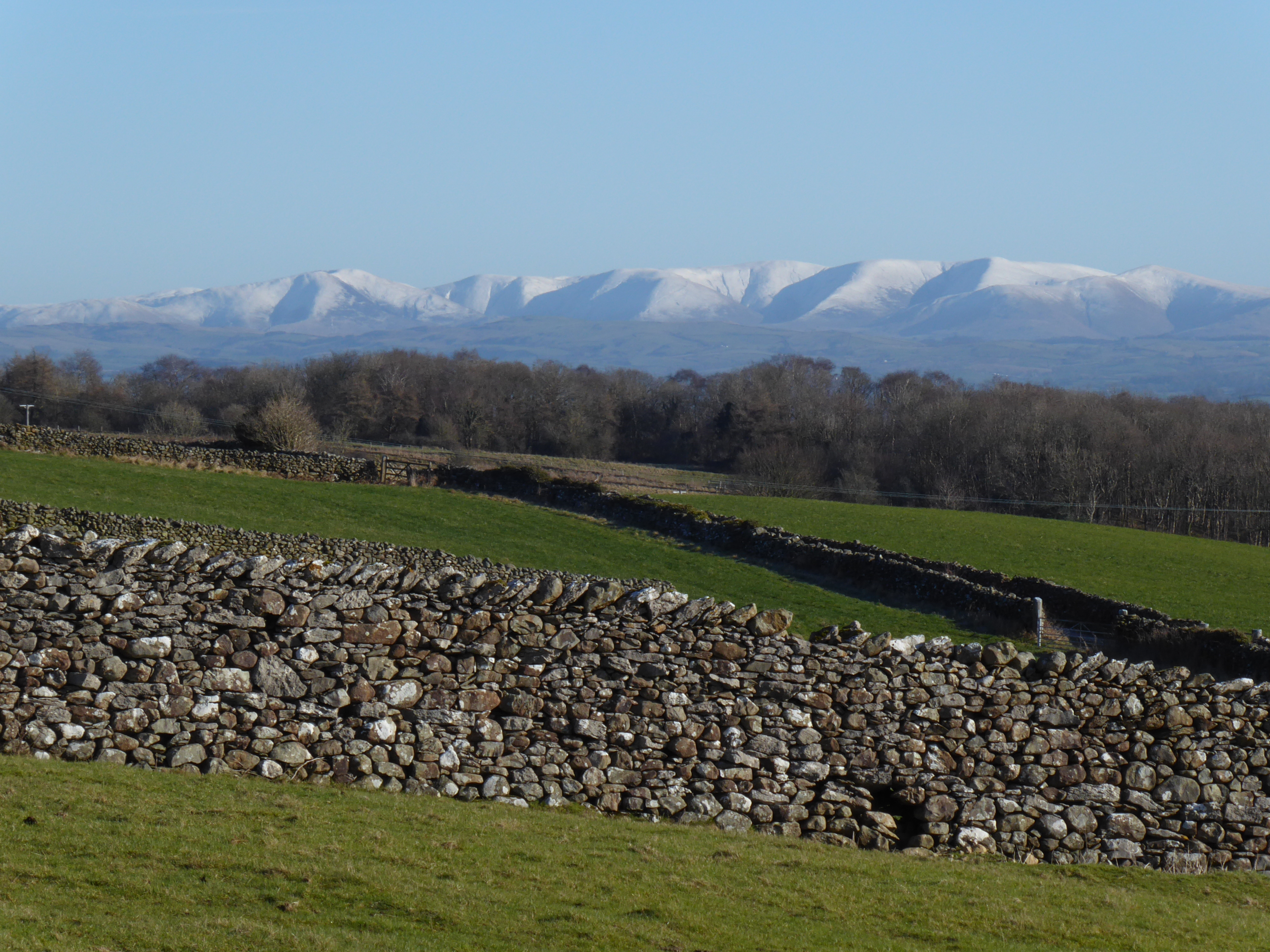
Truth be told, it was quite a dull walk. It sounds great to have views of the Lakeland hills, but – not wishing to sound ungrateful – a grey day highlights the monogreen bareness of the land. Thank goodness for serendipity: hens, another Thirlmere gate (built to enable engineers to maintain the Thirlmere aqueduct) and my first sighting of massed St George’s flags on an estate in Kendal. I’m still thinking about the latter.