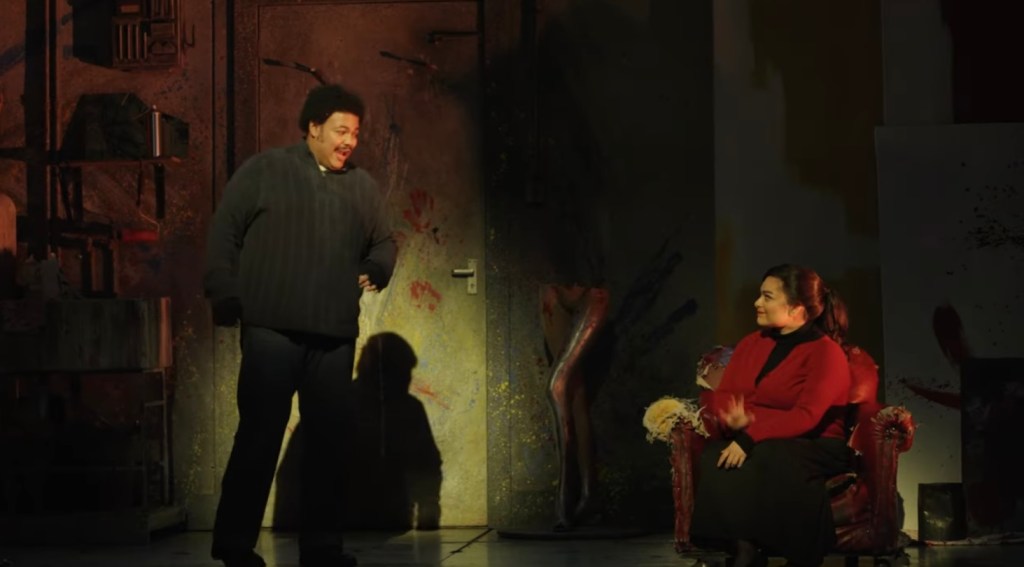
Another version of La Bohème, set in the 1950s/60s. It was very good on youthfulness and men larking about, and Rodolfo’s aria sent tears down my cheeks.
- Rodolfo – Joshua Blue
- Mimi – Isabela Diaz
- Marcello – Josef Jeongmeen Ahn
- Musetta – Katie Bird

Another version of La Bohème, set in the 1950s/60s. It was very good on youthfulness and men larking about, and Rodolfo’s aria sent tears down my cheeks.
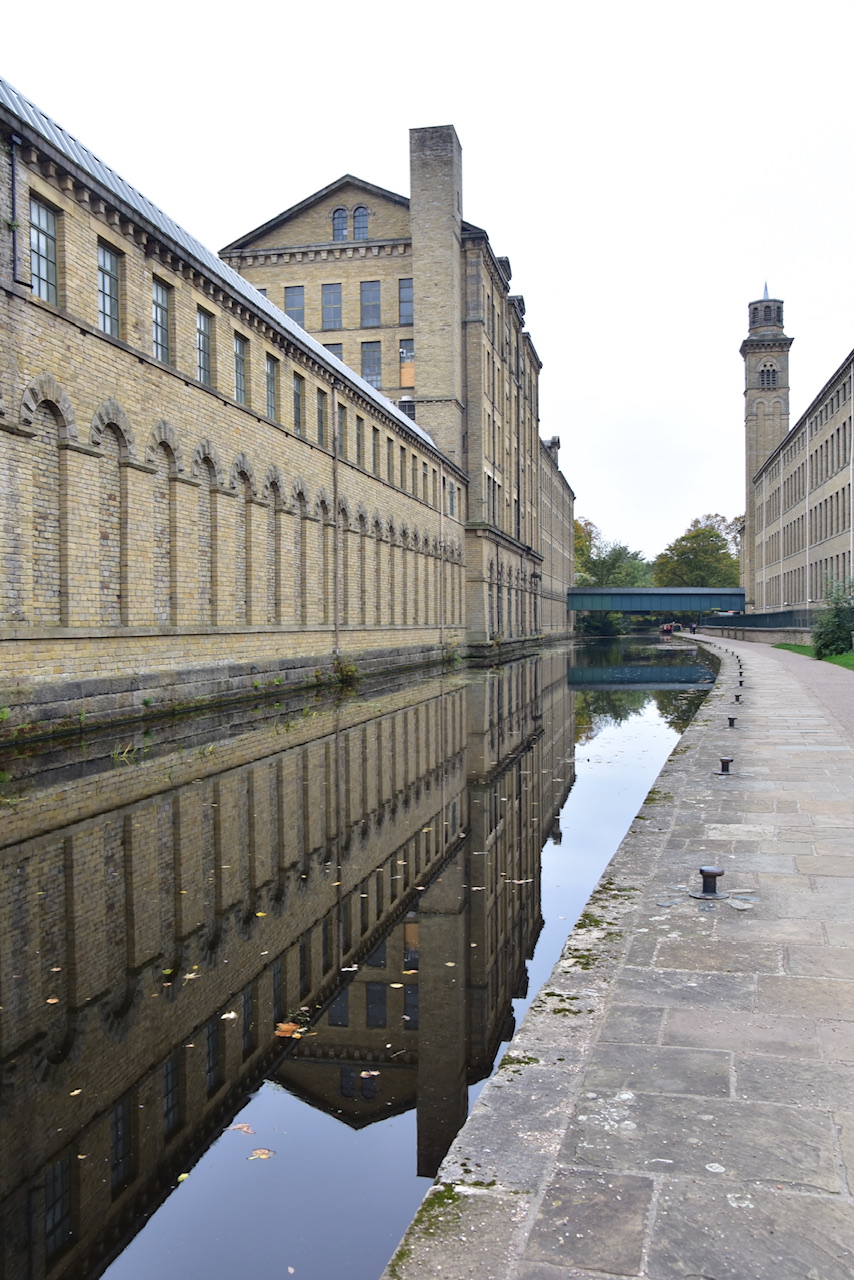



Leeds, Shipley, Saltaire, a walk around Shipley Glen and along the Aire and the canal – then back to Saltaire, Shipley, Leeds. A lovely day, and I discovered the Shipley tramway. It was so short a line that I couldn’t imagine its purpose. I have since discovered that it is a funicular tramway built simply, in bygone times, to take people to funfair attractions at the top of the hill.
It’s been a damp day – more like gloomy November than crisp October – but it did outline some wonderful floating webs on the box.



Director Terence Davies
I have certainly watched a variety of films over the last fortnight. This was definitely my favourite. It swept me up, whereas The Green Ray and Radio On engaged only my curiosity and my brain. I don’t know how autobiographical it is: scenes of a boy’s life in 1950’s Liverpool, his loving family, the magic of the cinema, the brutality of his new school and the guilt-inducing teachings of the Roman Catholic faith – particularly for a boy attracted to his own sex. Memories are heightened: the rain always lashes down, women’s lipsticks are as red as can be, everyone has a good singing voice, his mother is the epitome of lovingness, the wonderful dream-like tableau of his family at Christmas straight out of Hollywood. The nit nurse is witch-like (rather as Miss Gulch turned into the Wicked Witch of the West) and the teachers are Dickens’s caricatures. Via the film, the ex-child shows how the long day – his carefree happiness? – closed with his new school, growing up, his former playmates running off to the cinema without calling for him; refusing to run after them, he retreats to the coal cellar, the shadow of the area railings and loneliness.
Go to the dreamless bed
Where grief reposes;
Thy book of toil is read,
The long day closes.
The soundtrack is every bit as significant as Radio On. The opening credits are like a lush Hollywood biopic, written in copperplate so elegant that it’s almost unreadable. The music is, I think (I could check), that which The Ladykillers appear to play as they plan their crime, and the opening scene is very much like that street . . . and, yes, here is Alec Guinness’s voice enquiring about a room. You read the screen images as carefully as any religious painting. Thresholds, front doors, narrow staircases are as significant as St Lucy’s eyes on a plate. When he’s standing in the lashing rain outside the cinema asking an adult to take him in – shades of Gene Kelly about to start singing in the rain?
Strange how the sentimental scenes in Dead of Winter left me cold but in this film I basked in their warmth. Perhaps because they left space for/contrasted with other emotions – and perhaps because I suddenly recalled that my father used to sing when I was a child. Even now I can hear him singing “The voice in the old village choir” (“accompanied” by me as the bells’ dongs) – now there’s a whole meta-chain of nostalgia!
Director Christopher Petit with David Beames
I thought about “radio off” partway through, but I persevered. It’s got to be a cult film for a reason, I reasoned. An English road movie – all the way from London to Bristol! – with a great soundtrack.
An odd, disaffected film that made me think of J G Ballard and Michelangelo Antonioni. Was there a plot? It was partly financed by the German film industry, and it shared that bleakness and gloom that put me off German films forty years ago. 1979 rushed back to me, but this time I experienced it from the eyrie of age. What happened to all that postwar optimism and rebuilding? How did it turn into this alienating, emotionally stunted world, shot in inky B&W, stripped bare – not of luxuries (for simplicity would be preferable), but of essentials? Where is friendliness, love, interaction, nature, warmth, beauty? It was all concrete and tarmac rather than softness, hostility rather than kindliness, hard core pornography rather than love, screens rather than real life. Potential emotional cores – his brother’s suicide, the German woman looking for her little daughter – were perfunctory. (The little girl now spoke a different language to her mother: intimacy was always fragile.) The acting was minimal, devoid of feeling unless it was anger or irritation. What was the point of it all? What was the director trying to convey? Anything at all? Was it just self-referentially “cinematic”?
I’m still not sure about that, but it definitely had the feel of its time. The camera lingered on things that I had gazed at myself: peeling paint, pylons, petrol pumps. I had forgotten how big women’s hair was in the late 70s and how voluminous their clothes until the two German women appeared. The feel of driving a car – something I did only at that period of my life – or just travelling in a car came back to me with all those shots through the windscreen. The underlying violence of the period – Northern Ireland always in the news, terrorism on the Continent. A film of impressions.
Director Brian Kirk with Emma Thompson
With the weather and my aches, I was getting cabin fever so an evening at the cinema appealed. This film fitted the bill: I was engrossed while watching it (although cavilling at the over-sentimental flashbacks) and happily picked it to pieces on the way home. Emma Thompson is great as a kind, grieving widow who unleashes her inner Rambo when she discovers a dreadful crime. The winter landscape is perfect for the action: a shoot-out between the Wicked Witch and the Fairy Godmother to keep Snow White. It’s pretty ludicrous – but I wasn’t bothered by that.
I feel as if I should be writing an essay on the themes of this novel, its recurring images, its modernism and streams of consciousness that lead to a great sea of life – and then hand it in to be marked. But no – I shall just note what struck me on my first reading.
I’ve never read Ulysses (and have no inclination to), but I assume there are similarities. Is it telling that there is no great legendary female voyager to represent Mrs Dalloway? Her geographical range is narrow – Central London and somewhere in the country – but her temporal range is from girlhood to her current age. There were echoes of The Wasteland too – shell-shocked Septimus and I had not thought death had undone so many, the bells that keep the hours.
Women/girls and flowers/the natural world. We first meet Mrs Dalloway as she sets off to buy some flowers (cut, already picked) for that night’s party; her daughter is now of an age where men see her as a flower to be plucked:
She was like a poplar, she was like a river, she was like a hyacinth, Willie Titcomb was thinking . . .
I found myself very taken by the attempts to encompass everything of a person’s thoughts: the constant flowing between youth and middle age in one’s head while clocks strike the hours:
For she was a child, throwing bread to the ducks, between her parents, and at the same time a grown woman coming to her parents who stood by the lake, holding her life in her arms which, as she neared them, grew larger and larger in her arms, until it became a whole life, a complete life, which she put down by them and said, ‘This is what I have made of it! This!’ And what had she made of it?
So many characters whose lives briefly touch. Septimus and his suffering Italian wife. The repellent and conflicted – but also suffering – Miss Kilman. Their lives appear dreadful against the worldly comforts of the Dalloways and their friends. Reticence: Mr Dalloway intends to tell his wife that he loves her, but he passes up the opportunity to yet, involuntarily, he tells his daughter how lovely she is. Age brings with it complications that we are only dimly aware of.
Perhaps Sally’s final words are the ones to be heeded: “What does the brain matter . . . compared with the heart?”
Just brilliant.
 Old Shoe Box