The Marriage of Figaro

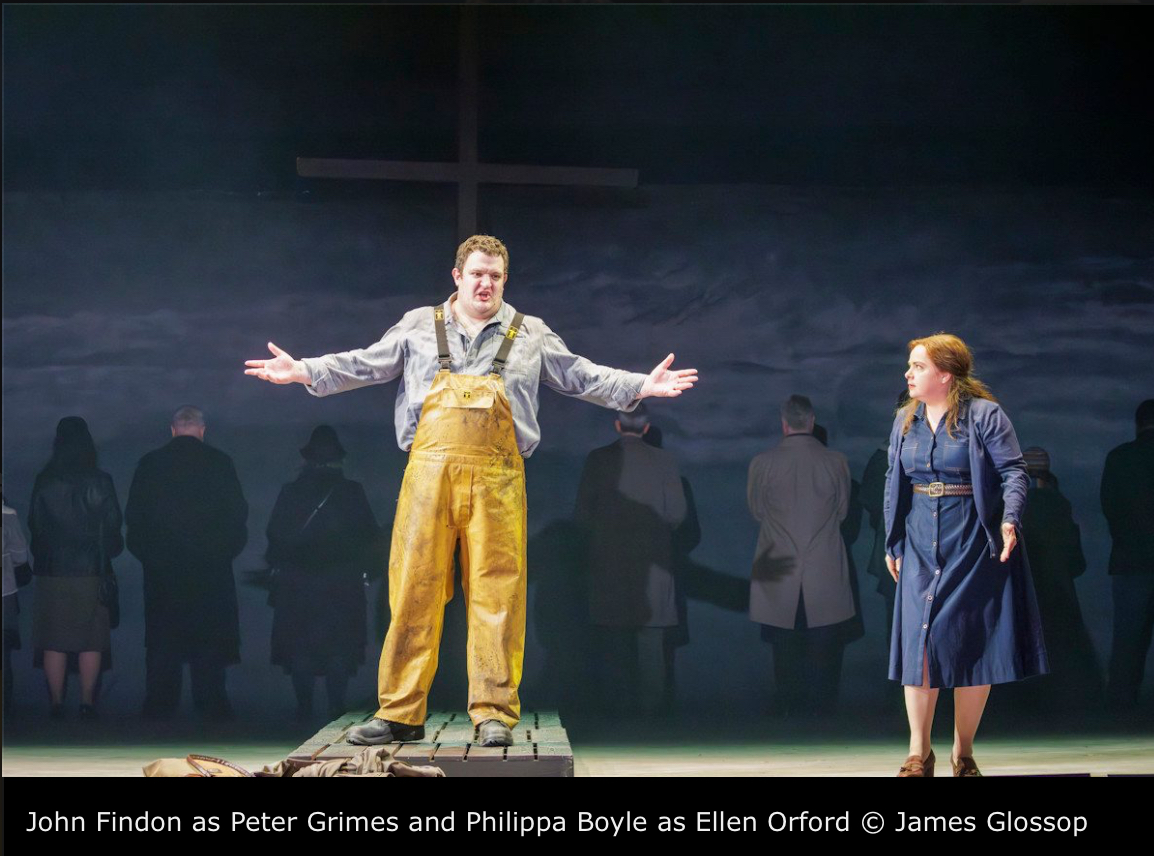
The third time I have seen this in Leeds, but this was a completely new production. Inadvertently I booked my seat for the first night. Perky, amusing and very well done. It’s nit-picking to suggest that setting it in the age of mobile phones jars with the droit de seigneur that drives the plot; after all, it is an opera so verisimilitude is not expected. The farcical scenes were excellently done yet left room for pathos for the Countess. It was wonderful to hear seven voices at once in the lawyer’s scene.

  • Figaro – Liam James Karai
  • Susanna – Hera Hyesang Park
  • Count Almaviva – James Newby
  • Countess Almaviva – Gabriella Reyes

I noticed that all the principal singers were new to me. Also that clapping after almost every aria has become the norm.

Leeds today

It was too cold and dank a day to want to do anything more than mooch up to the art gallery and look at the J Atkinson Grimshaw exhibition, “Nocturnes”.
No great surprise to learn that, as an artist, he was self-taught. (He obviously didn’t spend hours in life drawing classes.) He also churned out favourite scenes, as I discovered when looking online. But, oh, the light and shadows by Roundhay Park! The exhibition included some modern works to complement Grimshaw; they rather faded into insignificance beside his, but I noticed paintings by Judith Tucker that had been on display in the Burton Gallery – chosen, presumably, because of the lighted windows in dark landscapes.
There were also two extracts by Charles Dickens and James McNeill Whistler. Given yesterday’s visit to the Thackray Museum, I was inclined to view Grimshaw’s murky, polluted River Aire through Dickens’s eyes.

But the river had an awful look, the buildings on the bans were muffled in black shrouds, and the reflected lights seemed to originate deep in the water, as if the spectres of suicides were holding them to show where they went down. The wild moon and clouds were as restless as an evil conscience in a tumbled bed, and the very shadow of the immensity of London seemed to lie oppressively upon the river.

Charles Dickens

And when the evening mist cloths the riverside with poetry, as with a veil, and the poor buildings lose themselves in the dim sky, and the tall chimneys become campanili, and the warehouses are palaces in the night, and the whole city hangs in the heavens and fairy-land is before us – then the wayfarer hastens home; the working man, and the cultured one, the wise man and the one of pleasure, cease to understand, as they have ceased to see, and Nature, who, for once, has sung in tune, sings her exquisite song to the artist alone, her son and her master – her son in that he loves her, her master in that he knows her.

James McNeill Whistler

As for the rest: I would happily have stolen the Inchbold, the Tunnard seemed to approach Ignatius Riley’s “geometry and theology” criteria (although undoubtedly falling short doctrinally), and on my way back I noticed a bus going to Roundhay Park. Grimshaw lives!

Thackray Museum of Medicine

It was an unlovely walk along Burmantofts Road to the museum; grey skies, damp cold, traffic, uninspiring housing, the absence of “theology and geometry” (I’ve just finished reading A Confederacy of Dunces) all conspired against optimism. But, really, it was nothing compared to what I was about to see of life in 19th-century Leeds.

What is now the museum was originally built as a workhouse (1858) then later became a hospital. It’s imposing and ornate – lots of Dutch gables and Burmantofts tiles – but the thing that struck me at first was how BIG it is. It was built for 800 people; I don’t know how much misery and mental distress they experienced here, but living directly opposite the Leeds burial ground (27,000 graves with 180,000 interments) can’t have helped. Perhaps it was preferable to what had gone before or life outside – particularly when “life outside” in Leeds before the passing of 1848 Public Health Act seemed utterly revolting. (Edwin Chadwick as a benevolent social reformer or a centralising bureaucrat with a purely utilitarian approach to the health of the working population? Did it matter?)

The reason I went was to see the Lorina Bulwer scroll (1904). In her fifties she was put in the lunatic ward of the Great Yarmouth workhouse, where she embroidered this. But there was so – too! – much more to take in. I started off with Disease Street and began contemplating what it must be like to live cheek by jowl with no sewerage system or rubbish disposal and polluted air. With, perhaps, a meat market/abattoir at the end of the road. Public health measures brought disease reduction in their wake. Then the treatment of diseases and illnesses, the adoption of a more scientific approach (germ theory rather than divine punishment) but still contending with deep-rooted ignorance (poor Semmelweis). Medical advances: I had forgotten that Fanny Burney underwent a mastectomy without anaesthetic, and I finally understand how an iron lung worked (although it still looks like an instrument of torture). I still have a soft spot for the unscientific, though: the doctrine of signatures, leech jars, the lovely apothecary jars, the four humours (blood, phlegm, black bile, yellow bile).

On my way back along I stopped to photograph a pointlessly polite sign and its self-important initial caps.

Turner in Time

A very wet and windy day, but the trains were running and that was enough for me. To the Whitworth for yet another Turner exhibition. This one was of Turner’s watercolours (low status compared to oil painting) from his teens to his old age – from precision to impression. I enjoyed watching the change in style as I wandered around the room and noticed how he embraced innovation (e.g. coloured paper for his watercolours). Some scenes were already familiar, like the fall of the Clyde in Lanarkshire.

As usual, there were other small exhibitions to dip into. One on trees in art, which was rather lovely, and one on abstract art, which wasn’t. Minimalism is OK, but the “messiness” of, say, Gillian Ayres means nothing to me, Well, my loss perhaps. Included in the exhibition room were fabric and textile designs from Edinburgh Weavers and Hull Traders – abstraction tamed and tidied into repeating patterns.

Turner and Constable

I set off for the Tate on foot and continued walking when the rain started, preferring to avoid crowds while I could for I knew the exhibition would be busy. It was indeed sold out for the day, and the cloakroom was quickly full.

The exhibition looked at Turner (b 1775) and Constable (b 1776), comparing their works and their success (the former seen at the time as “poetic”, the latter “truthful”). Turner travelled widely, portraying the sublime and maximising income from his output through his prints; Constable painted closer to home, often out of doors, trying to capture natural features and atmospheric effects as truthfully as he could. There was a sketch of Helmingham Dell which I wanted to steal: it combined the charm of poohsticks bridge with the elemental forest scenes in Hamnet. I much preferred his smaller works to his “six-footers” – paintings designed to be noticed at exhibitions. (Turner had learned that lesson early on.) It was interesting to compare Constable’s experiments with his brushwork – usually textured (which critics had divided opinions about), but occasionally smoother.

Again, I preferred Turner’s later, less finished paintings. There are only so many scenes of ravines, cliffs and castles that I can take. His unfocussed views leave more room for interpretation.

I wandered around the regular galleries too, and noted a painting of Mrs Mounter by Harold Gilman that I was sure I had seen last month at the Walker. Yes, I had – Mrs Mounter was a regular model for Gilman; I’ve even seen her in Leeds. The main hall had a selection of Jacob Epstein’s sculptures, and I was struck anew by the Rock Drill torso. Epstein changed the sculpture (originally more sinister) after WWI, amputating some of it and casting it in bronze, and the result is somehow sorrowful – almost like a Pietà with bowed head and arm reaching out in supplication.

I also spent time with William Stott of Oldham. Undemanding . . . but so lovely.

V&A East Storehouse

Another whim. I’d never been to the Queen Elizabeth Olympic Park, despite years of going past it on the train to Manningtree and Harwich and watching the site being developed for the Olympics, so getting off at Stratford International was a first. It’s a fairly unlovely place – the River Lea is brown and the architecture bland – but on a fine day it didn’t matter.

The V&A Storehouse is indeed a storehouse – similar to the Boijmans van Beuningen Depot in Rotterdam but without the exterior wow-factor. You wander around as you wish; there are a few labels, some QR codes and heavy large-print catalogues. It’s very Instagrammable from certain angles, but I confess – much as I was charmed with it – I did come away with the impression that the V&A could have a clear-out. I appreciate that you’d have to hang onto a piece of Chinese tapestry-woven silk (1368-1644, which is quite a range), and a bit of the façade of the now-demolished Robin Hood Gardens tells its own story . . . but the moth-damaged vintage Harvard trucker baseball cap, date, location and maker unrecorded? Really?

While looking for somewhere for lunch, I passed the old Daily Telegraph building in Fleet Street and noticed above the door the mirror images of Mercury taking messages east and west, which reminded me of the image above the entrance to the Radio Kootwijk transmitter building.